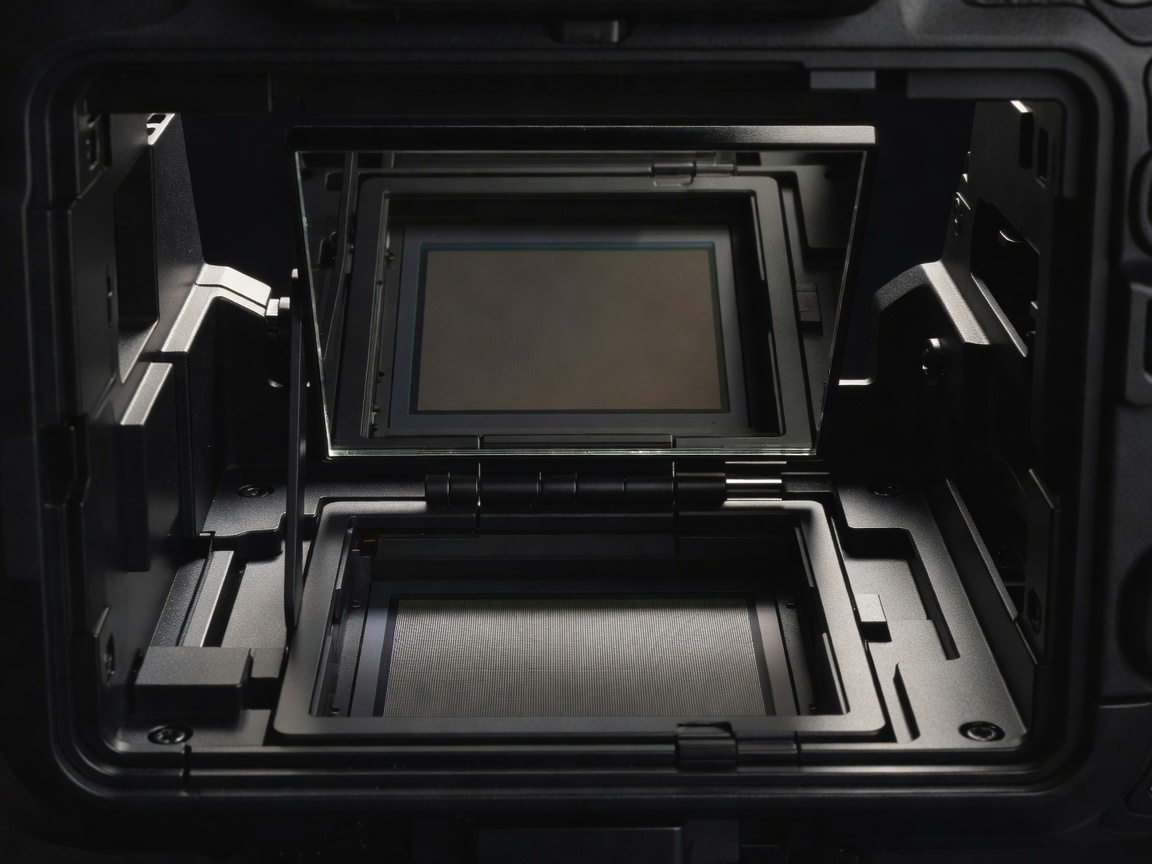
Digital Single-Lens Reflex (DSLR) cameras inherited their core architecture from 35mm film SLRs. The defining feature of this system is the internal mirror box. A mirror sits at a 45-degree angle behind the lens mount, reflecting light up into an optical viewfinder prism.
Because this mirror physically flips up out of the way when you take a photo, there must be empty space between the back of the lens and the sensor. This mechanical necessity results in relatively long flange focal distances across all DSLR systems.
Nikon F (46.50mm)
One of the longest-running and longest-flanged mounts in history. Because its flange is so deep, it is nearly impossible to adapt other vintage lenses (like M42 or Canon FD) to a Nikon DSLR without using an adapter with a built-in glass element, which degrades image quality.
Canon EF (44.00mm)
Introduced in 1987, the fully electronic EF mount was revolutionary. Its slightly shorter 44mm flange made it the darling of early video shooters and vintage lens enthusiasts, as it could accept M42, Nikon F, and Olympus OM lenses with simple, glassless metal adapter rings.
Pentax K (45.46mm)
Designed to be backwards compatible with their M42 screw mount heritage (via a flush adapter). Pentax DSLRs remain popular for purists who want native support for decades of excellent, affordable manual focus glass.
The Adapter with Glass Problem
If you attempt to mount a lens with a 42mm flange (Canon FD) onto a camera with a 44mm flange (Canon EF), a plain metal ring physically cannot push the lens 2mm deep inside the camera body. To achieve infinity focus, manufacturers create adapters with a small magnifying lens built in. While this solves the math, it acts as a cheap teleconverter, introducing softness, chromatic aberration, and altering the focal length. For purists, this is unacceptable, making DSLRs poor receivers for many vintage systems.